


French existentialism is a philosophical movement that emerged in mid-20th century France, centered on the conviction that human beings create their own meaning through free choice and action in an otherwise indifferent universe. Rather than appealing to divine command, natural law, or universal reason, this tradition places radical responsibility on individuals to define their existence through concrete decisions. The movement is most closely associated with Jean-Paul Sartre, Simone de Beauvoir, Albert Camus, and Maurice Merleauau-Ponty, intellectuals whose work transformed not only academic philosophy but literature, politics, and cultural debate across postwar Europe.
For contemporary bioethics, French existentialism offers more than historical context. It provides conceptual tools directly relevant to medical practice in 2026. When patients face end-of-life decisions, consent to experimental treatments, or navigate reproductive choices, they confront precisely the existential predicaments these philosophers examined: the burden of freedom, the absence of objective guidelines, and the need to choose authentically in situations marked by uncertainty and finitude. Healthcare professionals, too, operate in moral terrain where protocols and evidence-based guidelines meet the irreducible particularity of individual lives.
This article explains what French existentialism is, how its central concepts function, and which thinkers shaped its development. More importantly, it demonstrates how this philosophy informs current debates in medical ethics, from patient autonomy and advance directives to the ethical status of embryos and the medicalization of human suffering. By examining real-world case studies where existentialist insights clarify contemporary dilemmas, we reveal why a 75-year-old movement remains vital for anyone grappling with the ethical dimensions of healthcare. The goal is not to prescribe answers but to sharpen the questions practitioners and policymakers must ask.
What French Existentialism Means: Core Philosophical Commitments
French existentialism rests on a radical reversal of traditional philosophy’s priorities. Where classical thinkers sought universal essences, fixed human nature, predetermined purposes, eternal truths, the existentialists insisted that we exist first and define ourselves through lived experience and choice. There is no blueprint for human life handed down by God, nature, or reason. Instead, each person confronts the unsettling freedom to create meaning in a world that offers no inherent guidance.
This philosophical stance yields several core commitments that distinguish French existentialism from other ethical traditions and make it particularly relevant to bioethical reasoning.
Existence Precedes Essence
The movement’s foundational principle holds that humans have no fixed nature or predetermined purpose. We are “condemned to be free,” as Sartre put it, thrust into existence without instruction manual or cosmic job description. A knife has an essence, it was designed to cut, but a person must forge their own identity through decisions and actions. In medical contexts, this principle challenges paternalistic models that assume doctors know what’s objectively best for patients. If existence precedes essence, then a good life for one person may look entirely different from another’s, and healthcare must respect this radical particularity.
Radical Freedom and Responsibility
French existentialists argue that we possess far more freedom than we typically acknowledge, and with it comes total responsibility for our choices. We cannot blame genetics, upbringing, social position, or diagnosis for who we become. This view proves both liberating and terrifying. A patient facing a terminal diagnosis still chooses how to respond, whether to pursue aggressive treatment, seek palliative care, or request medical aid in dying. The existentialist framework honours these choices as expressions of authentic selfhood rather than reducing them to symptoms, irrationality, or family obligation.
- Existence Precedes Essence
- The principle that humans have no predetermined nature or purpose; we create our identity through choices and actions rather than fulfilling a pre-existing design.
- Bad Faith
- Self-deception through which we deny our freedom and pretend our choices are determined by external forces, roles, or circumstances we cannot control.
- Facticity
- The unchangeable facts of our situation, our body, birthplace, history, mortality, that limit but do not eliminate our freedom to interpret and respond to these conditions.
- Transcendence
- Our capacity to project beyond present circumstances toward future possibilities, refusing to be defined entirely by current facts or past events.
- The Absurd
- The fundamental mismatch between our human need for meaning and the universe’s silence, creating a tension we must acknowledge rather than escape through false certainty.
- Authenticity
- Living in full acknowledgment of one’s freedom and mortality, making choices that reflect genuine values rather than conforming to external expectations or self-deception.
Subjective Experience as Primary
Unlike bioethics approaches grounded in universal principles or consequences, existentialism privileges first-person perspective. What matters most is how the patient experiences their illness, disability, or treatment, not what medical taxonomy says about their condition or what statistics predict about outcomes. A chronic pain patient’s subjective reality takes precedence over diagnostic imaging that shows nothing wrong. This commitment to lived experience challenges medicine’s tendency to treat bodies as objective mechanisms while ignoring the person inhabiting that body.
Confronting Absurdity and Ambiguity
French existentialists, particularly Camus, recognized that life offers no ultimate answers to our deepest questions. We want to know why we suffer, whether treatment will work, what gives life meaning in the face of death. The universe provides no response. Rather than flee into religious consolation or scientistic certainty, existentialist ethics asks us to live well despite this silence. For bioethicists, this means accepting that some dilemmas have no clean resolution, that guidelines cannot cover every case, and that tolerance for ambiguity is a professional necessity rather than intellectual weakness.
These commitments converge in medical decision-making. A patient choosing whether to undergo chemotherapy faces their existence precedes essence (no predetermined “right” answer), radical freedom (the decision is genuinely theirs), subjective experience (their quality-of-life calculations matter most), and absurdity (no guarantee of outcome or cosmic justice). Existentialist bioethics insists we honour that burden rather than pretending to lift it through false certainty or paternalistic shortcuts.
Major Figures and Their Distinct Contributions

Jean-Paul Sartre: Freedom and Radical Responsibility
Jean-Paul Sartre’s dictum that “existence precedes essence” places radical freedom at the center of human existence. For Sartre, we are “condemned to be free”, thrust into a world without predetermined nature or purpose, bearing absolute responsibility for every choice we make. This position challenges medical paternalism at its philosophical roots. When a physician recommends treatment, Sartre would insist the patient remains fundamentally free to accept or refuse, regardless of clinical evidence or expert opinion. Informed consent becomes not merely a legal requirement but an ethical imperative rooted in the structure of human existence itself.
This framework exposes tensions with contemporary approaches like nudges in bioethics which guide decisions through choice architecture while preserving formal autonomy. Sartre would recognize such interventions as attempts to evade the anguish inherent in genuine freedom. His existentialism demands we acknowledge patients as authors of their medical narratives, bearing full responsibility even when choices lead to suffering or death, a demanding vision that refuses the comfort of deferred accountability.
Simone de Beauvoir: Situated Ethics and the Body
Simone de Beauvoir’s ethics of ambiguity rejects both absolute moral certainty and nihilistic despair, arguing instead that ethical life unfolds through situated freedom, we are neither purely determined nor wholly autonomous. Her 1947 work The Ethics of Ambiguity insists that authentic moral action acknowledges our embeddedness in bodies, relationships, and concrete circumstances while refusing to abdicate responsibility for our choices. This framework proves especially powerful for bioethics, where patients navigate constraints of diagnosis, prognosis, and social context yet retain meaningful agency.
In The Second Sex (1949), de Beauvoir established the body not as biological destiny but as a situation we interpret and inhabit. Applied to reproductive autonomy, this means pregnancy involves both bodily constraint and radical freedom to define its significance. De Beauvoir’s insistence that “one is not born, but rather becomes, a woman” grounds arguments for gender-affirming care: gender identity emerges through lived experience and self-interpretation, not chromosomal determinism.
Her ethics of care, recognizing our mutual vulnerability and interdependence, challenges the Sartrean myth of the solitary chooser. In clinical contexts requiring trust, dependency, and collaboration, de Beauvoir’s relational existentialism offers a more adequate foundation than atomistic autonomy.
Albert Camus: The Absurd and Meaning-Making in Medicine
Albert Camus rejected the label “existentialist,” yet his philosophy of the absurd offers distinct resources for bioethical reasoning that complement Sartre’s and de Beauvoir’s frameworks. For Camus, the absurd arises from the collision between our human demand for meaning and the universe’s indifference to that demand. In medical contexts, this tension becomes acute: patients facing terminal diagnoses or chronic suffering confront what Camus called “the fundamental question”, whether life remains worth living when stripped of illusions about cosmic purpose or guaranteed recovery.
Unlike nihilism, which concludes that meaninglessness justifies despair or suicide, Camus’s response involves what he termed “revolt”, the conscious decision to embrace life and create meaning despite the absence of inherent purpose. This stance has profound implications for clinical ethics. When oncologists deliver terminal prognoses or patients navigate incurable conditions, Camus’s framework validates the subjective creation of meaning rather than relying on religious consolation or biomedical cure as prerequisites for a worthwhile existence. His insistence that we must imagine Sisyphus happy suggests that patients retain agency in defining what makes their remaining time valuable, even when medicine offers no pathway to healing.
Maurice Merleau-Ponty: Embodiment and Phenomenology
Maurice Merleau-Ponty redirects existentialist philosophy away from abstract consciousness and toward the lived, sensing body. For him, we do not simply have bodies; we are our bodies, experiencing the world through perception before any conceptual thought takes hold. This challenges the Cartesian dualism that haunts much of Western medicine, where the body is treated as a malfunctioning object separate from the person inhabiting it.
In clinical contexts, Merleau-Ponty’s phenomenology offers crucial insights into disability and chronic illness. A patient with paralysis does not just lose motor function, their entire experiential world transforms. Their bodily schema, the pre-reflective map through which they navigate space and possibility, must be relearned. Similarly, chronic pain is not merely a symptom to manage but a mode of being that reshapes one’s relationship to time, movement, and selfhood.
This framework demands that healthcare professionals attend to the patient’s first-person experience rather than relying solely on objective measurements. A tremor is not just a neurological sign; it is a disruption of how someone reaches for a cup, writes their name, or maintains dignity in social space. Merleau-Ponty’s work insists that ethical care requires grasping illness as embodied experience, not merely biological dysfunction.
How French Existentialist Ethics Works in Practice

French existentialist ethics rejects the rigid application of universal moral principles in favor of a methodology that starts with the concrete situation and the lived experience of the individuals involved. Rather than consulting a predefined rulebook, existentialist bioethics asks: What does this patient’s suffering mean to them? What authentic choices remain available in their particular circumstances? How can we honor their freedom while acknowledging the irreducible ambiguity of medical decision-making?
The practical operation of this approach differs fundamentally from traditional bioethical frameworks. Where principlism might apply the four principles of autonomy, beneficence, non-maleficence, and justice uniformly across cases, existentialist ethics insists that each clinical encounter is irreducibly unique. A treatment refusal that appears irrational from an external medical perspective may represent an authentic assertion of selfhood for the patient. The methodology requires clinicians and ethicists to bracket their preconceptions and enter the patient’s subjective world.
Consider a concrete scenario: a young woman diagnosed with a genetic mutation that significantly increases cancer risk must decide whether to undergo prophylactic surgery. Conventional genetic engineering ethics might emphasize statistical risk reduction and evidence-based recommendations. Existentialist ethics, by contrast, centers her embodied experience, her relationship to her own mortality, and the meanings she assigns to bodily integrity, future possibility, and reproductive capacity. No guideline can determine the right answer because the decision’s significance is fundamentally subjective.
Key operational principles distinguish existentialist bioethics in clinical practice:
- Centering patient narrative as primary ethical data rather than treating it as supplementary to medical facts
- Acknowledging irreducible uncertainty and resisting the false comfort of algorithmic decision-making
- Respecting authentic choice even when it conflicts with medical recommendations or majority values
- Rejecting paternalistic authority that substitutes expert judgment for patient self-determination
- Embracing situational judgment that accounts for context, relationship, and individual meaning
This methodology proves particularly valuable in domains where medical facts underdetermine ethical choices. In debates about reproductive autonomy existentialist ethics refuses to reduce pregnancy to a biological state or embryonic status to a metaphysical question. Instead, it asks what this pregnancy means for this woman in her concrete situation, what future she is choosing, and how her embodied freedom is either enabled or constrained. Similarly, in stem cell ethics the framework resists abstract debates about potential personhood in favor of examining how research decisions shape actual human possibilities and respect or violate the conditions for authentic existence.
The challenge lies in operationalizing radical subjectivity within institutional healthcare. Existentialist ethics demands time, relationship, and tolerance for ambiguity, resources often scarce in contemporary medical systems.
Applications to Contemporary Bioethical Challenges
End-of-Life Decision-Making and Medical Aid in Dying
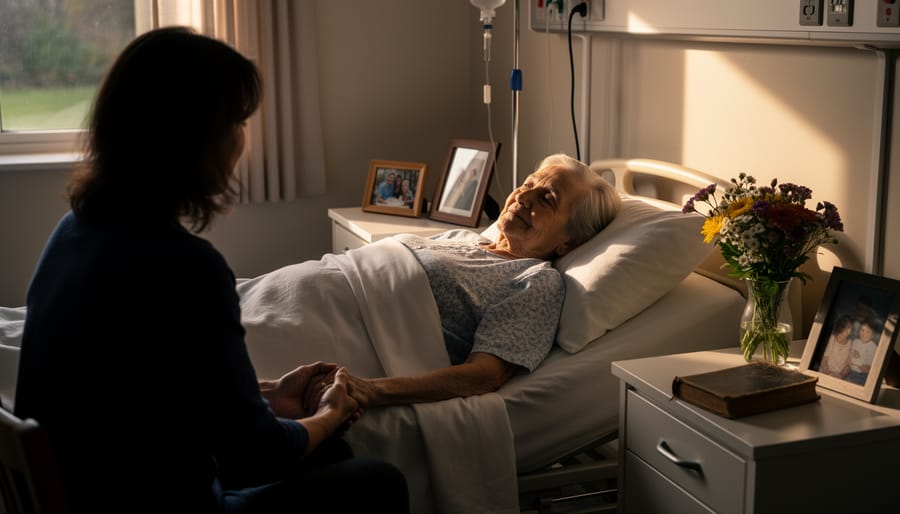
French existentialism offers a distinctive ethical framework for end-of-life decisions that centers the dying person’s lived experience rather than abstract principles. For Sartre, death represents the ultimate horizon of human freedom, the point at which our capacity to choose ends. This makes choices made in the face of death uniquely authentic, unconstrained by future consequences. A patient requesting medical aid in dying, from this view, exercises the same radical freedom that defines human existence throughout life. The decision cannot be delegated to physicians, family members, or even advance directives; it must emerge from the conscious, embodied self.
De Beauvoir’s ethics of ambiguity deepens this analysis by acknowledging that terminal illness often strips away the illusion of independent selfhood. Her framework respects both the patient’s irreducible subjectivity and the reality of dependence on caregivers, medical systems, and loved ones. Authentic choice at life’s end means confronting this ambiguity honestly, neither pretending the dying person exists in isolation nor allowing institutional power to override their agency. This perspective challenges both paternalistic medical models and simplistic appeals to “choice” that ignore how illness, pain, and healthcare inequities constrain what options feel genuinely available.
Camus’s philosophy of the absurd adds crucial nuance. While rejecting suicide as a philosophical solution to life’s meaninglessness, Camus distinguished between ending life in despair and choosing death as an authentic response to unbearable suffering. Medical aid in dying, in contexts of terminal diagnosis, represents not capitulation to absurdity but an assertion of human dignity against biological fate.
Genetic Engineering and Human Enhancement
French existentialism challenges the essentialist assumptions underlying much of the human enhancement debate. When genetic technologies promise to optimize traits like intelligence, physical prowess, or temperament, they smuggle in the notion that there exists a fixed human essence we can perfect, a claim Sartre explicitly rejected. For existentialists, humans are not defined by predetermined characteristics but by the projects they choose and the meanings they create through lived experience.
This critique cuts to the heart of designer baby discussions. Selecting embryos for specific traits treats the future person as an essence to engineer rather than a freedom to become. It transforms procreation from an encounter with radical openness into a manufacturing process with quality specifications. De Beauvoir’s emphasis on ambiguity proves particularly relevant: human flourishing resists reduction to measurable outcomes or genetic profiles.
Gene editing technologies like CRISPR raise similar concerns. While correcting disease-causing mutations might align with relieving suffering, enhancement interventions impose one generation’s values on another’s possibilities. They constrain the enhanced person’s freedom before existence even begins. An existentialist framework asks whether we can enhance human nature without betraying what makes us distinctively human, our capacity to transcend any given state and define ourselves through choice. This doesn’t foreclose all genetic interventions, but demands we distinguish between expanding human freedom and predetermining human essence.
Mental Health Ethics and Authenticity

Psychiatric treatment often assumes a clear distinction between illness and health, yet existentialist philosophy challenges this binary by questioning what constitutes an “authentic” self worth restoring. When a patient diagnosed with depression refuses medication, claiming their melancholy reflects genuine engagement with life’s absurdity rather than pathology, clinicians face a dilemma: does treatment liberate the patient from suffering or impose social conformity that suppresses authentic selfhood?
Sartre argued that psychological distress sometimes represents an honest confrontation with freedom’s burden rather than mere dysfunction. This perspective gains urgency in neurodiversity movements, where autistic and neurodivergent individuals assert that difference need not equal defect. An existentialist framework supports patient self-determination by recognizing that the individual alone can judge whether their experience represents authentic being or unwanted suffering.
Yet this stance risks romanticizing serious mental illness and abandoning vulnerable patients. De Beauvoir’s ethics of ambiguity offers balance: we must acknowledge both the genuine constraints mental suffering imposes and the patient’s irreducible authority over their own existence. Effective mental health ethics thus requires holding space for ambiguity, privileging first-person testimony, and recognizing that treatment goals must emerge from dialogue rather than diagnostic categories alone. The clinician’s role becomes not correcting deviation from norms but supporting the patient’s capacity for authentic choice.
Reproductive Rights and Embodied Autonomy
Simone de Beauvoir’s existentialist feminism provides a powerful philosophical foundation for contemporary reproductive justice frameworks. Her central insight, that one is not born, but becomes, a woman, directly challenges biological essentialism and establishes bodily autonomy as a precondition for authentic existence. De Beauvoir argued that women’s reproductive capacity has historically been weaponized to confine them to immanence rather than transcendence, denying them the freedom to define themselves through their own projects and choices.
In healthcare contexts, this framework illuminates why reproductive rights extend beyond simple legal permission to include genuine access: economic barriers, geographic isolation, and coercive medical practices all compromise the existential freedom necessary for authentic choice. De Beauvoir’s ethics of ambiguity recognizes that pregnancy decisions involve irreducible complexity and cannot be resolved through universal moral rules. Each decision emerges from a unique lived situation shaped by embodied experience, social constraints, and individual projects.
This existentialist approach reframes reproductive healthcare as fundamentally about enabling persons to exercise radical responsibility over their own bodily existence. It resists reducing women to their reproductive function while acknowledging how embodiment shapes lived experience. The framework proves especially valuable in contexts where bioethicists must balance respect for diverse values with recognition that authentic choice requires material conditions that make freedom genuinely possible.
Critical Perspectives and Limitations
While French existentialism offers powerful tools for bioethical reflection, it faces substantial critiques that warrant careful consideration. Feminist theorists building on de Beauvoir’s work have questioned whether the tradition’s emphasis on radical individual freedom adequately accounts for the structural constraints that shape human existence. Critics note that celebrating autonomous choice may obscure how systemic inequalities, in healthcare access, economic resources, and social power, fundamentally limit the options available to marginalized communities. When applied to clinical contexts, an existentialist framework risks framing ethical dilemmas as purely individual decisions while ignoring the social determinants of health that constrain patient agency.
Communitarian and care ethics scholars challenge existentialism’s individualist orientation. They argue that the tradition’s focus on personal authenticity and subjective experience understates our inherent interdependence and collective responsibilities. In healthcare settings, this critique becomes particularly salient: medical decisions rarely affect only the choosing individual but ripple through families, communities, and healthcare systems. Recent bioethics topic modeling research reveals how contemporary discourse increasingly emphasizes relational autonomy and care networks, frameworks that existentialism’s individualist lens struggles to fully accommodate. They argue that the tradition’s focus on personal authenticity and subjective experience understates our inherent interdependence and collective responsibilities. In healthcare settings, this critique becomes particularly salient: medical decisions rarely affect only the choosing individual but ripple through families, communities, and healthcare systems. Recent bioethics topic modeling research reveals how contemporary discourse increasingly emphasizes relational autonomy and care networks, frameworks that existentialism’s individualist lens struggles to fully accommodate.
The cultural specificity of French existentialism also merits scrutiny. Post-colonial theorists and non-Western philosophers have questioned whether concepts developed in mid-twentieth-century European contexts can address healthcare challenges across diverse cultural settings. African, Asian, and Indigenous philosophical traditions often emphasize communal belonging, harmony, and relational selfhood rather than individual authenticity and radical freedom. Imposing existentialist frameworks globally risks perpetuating intellectual colonialism and marginalizing alternative ethical traditions.
Does existentialism ignore social determinants of health?
Critics argue that existentialism’s emphasis on individual freedom can obscure how structural inequalities, poverty, discrimination, lack of healthcare access, constrain patient choices. This limitation is especially problematic when applied to vulnerable populations with limited agency.
Can existentialism account for collective responsibilities?
Existentialism’s individualist focus makes it challenging to address shared obligations in public health, resource allocation, and pandemic response. Care ethics and communitarian approaches may better capture our interdependence and duties to broader communities.
Is French existentialism too Western and Eurocentric?
Yes, according to post-colonial critics who note that the tradition emerged from specific European cultural contexts and may not translate well across diverse global settings. Alternative philosophical traditions emphasize communal values that existentialism underrepresents.
Practically, clinicians report difficulties operationalizing existentialist concepts in fast-paced healthcare environments. Abstract philosophical commitments to ambiguity and subjective meaning may offer limited guidance when protocols, time constraints, and institutional pressures demand concrete decisions. Some bioethicists suggest integrating existentialist insights with principlism, virtue ethics, or care ethics rather than relying on existentialism alone as a comprehensive ethical framework.
French existentialism offers bioethics something increasingly rare in medical decision-making: a philosophical framework that honours the irreducible complexity of human experience. In 2026, as healthcare systems grapple with genetic modification, artificial intelligence in diagnosis, and rapidly shifting definitions of personhood, the existentialist insistence on subjective meaning and radical freedom provides essential correctives to algorithmic certainty and bureaucratic protocols. Sartre’s concept of anguished responsibility, de Beauvoir’s ethics of ambiguity, Camus’s confrontation with absurdity, and Merleau-Ponty’s phenomenology of embodiment collectively resist the reduction of patients to data points or clinical categories.
Yet engaging with this tradition requires intellectual honesty about its limitations. The philosophers discussed here wrote from particular historical and cultural positions that shaped their blindspots, from undertheorizing structural oppression to centring individual choice in ways that can obscure systemic injustice. A responsible application of French existentialist thought to bioethics demands integrating insights from feminist care ethics, disability justice, critical race theory, and non-Western philosophical traditions.
The real value lies not in adopting existentialism as dogma but in wielding its core commitments as critical tools. When healthcare professionals and ethicists face genuinely novel dilemmas, the existentialist refusal of premade answers and insistence on acknowledging ambiguity can create space for more thoughtful, humane responses. That uncomfortable space between easy certainties remains precisely where ethical wisdom begins.